5 Effective Exercises to Strengthen Your Knees at Home
Spread Health and Love
Have you ever thought about exercising at home to build stronger, healthier knees?
Knee health plays a crucial role in how we move through daily life, affecting everything from our posture and balance to our independence and overall well-being.
Whether you’re bouncing back from an injury, dealing with a degenerative condition like osteoarthritis, or simply wanting to stay active and pain-free, targeting the muscles that surround and support the knee joint can make a remarkable difference.
In this article, I’ll introduce 5 straightforward, low-impact exercises you can do safely from your own home, no special equipment needed.
The Real Reason Your Knee Pain Never Goes Away
It's not age. It's not "just wear and tear." Most people are missing the root cause — and this natural formula targets it directly, fast.
The knee bears an enormous amount of stress throughout the day.
Everyday activities like walking, jogging, climbing stairs, crouching down, or standing for extended periods all place significant demand on this joint.
When the surrounding muscle groups — particularly the quadriceps, hamstrings, and glutes — are weak or underdeveloped, the knee ends up absorbing excess load.
Over time, this can lead to chronic pain, joint instability, and a higher risk of injury.
Strengthening these muscle groups helps shield the joint from unnecessary stress, supports proper postural alignment, and makes everyday movement feel more natural and effortless.
5 At-Home Exercises for Stronger Knees
1. Straight Leg Raise
This isometric movement primarily targets the quadriceps — the large muscle group running along the front of your thigh — without placing any direct stress on the knee joint itself.
It’s particularly valuable for people managing ligament injuries, post-surgical rehabilitation, or general knee discomfort, as it builds muscular control and prevents atrophy even when full joint movement isn’t yet possible.
How to do it:
Lie flat on your back. Bend one knee with the foot resting on the floor, and keep the other leg fully extended.
Tighten your core and contract the quadriceps of the straight leg.
Slowly raise the extended leg to the height of the opposite knee.
Hold for 2 seconds at the top, then lower in a controlled manner.
Complete 3 sets of 10–15 reps per leg.
Key tips:
Keep the working knee locked straight throughout the entire movement.
Press your lower back gently into the floor to avoid arching.
2. Wall Sit
The wall sit is a static lower-body exercise that uses a wall for support, making it an excellent option for those with limited joint stability.
By holding a seated position against the wall, you engage the quadriceps, glutes, and core muscles without any joint-loading movement.
Because it’s an isometric hold rather than a dynamic exercise, it’s especially suitable for beginners or anyone who finds traditional squats uncomfortable.
How to do it:
Stand with your back flat against a smooth wall.
Slide your body downward until your knees are bent at roughly 90 degrees, as if seated in an invisible chair.
Keep your feet hip-width apart and your heels directly below your knees.
Hold the position for 20 to 45 seconds.
Rest, then repeat for 3 rounds.
Why it works:
This exercise builds muscular endurance and joint stability — two key factors in reducing knee strain during activities like stair climbing, prolonged standing, or walking on uneven surfaces.
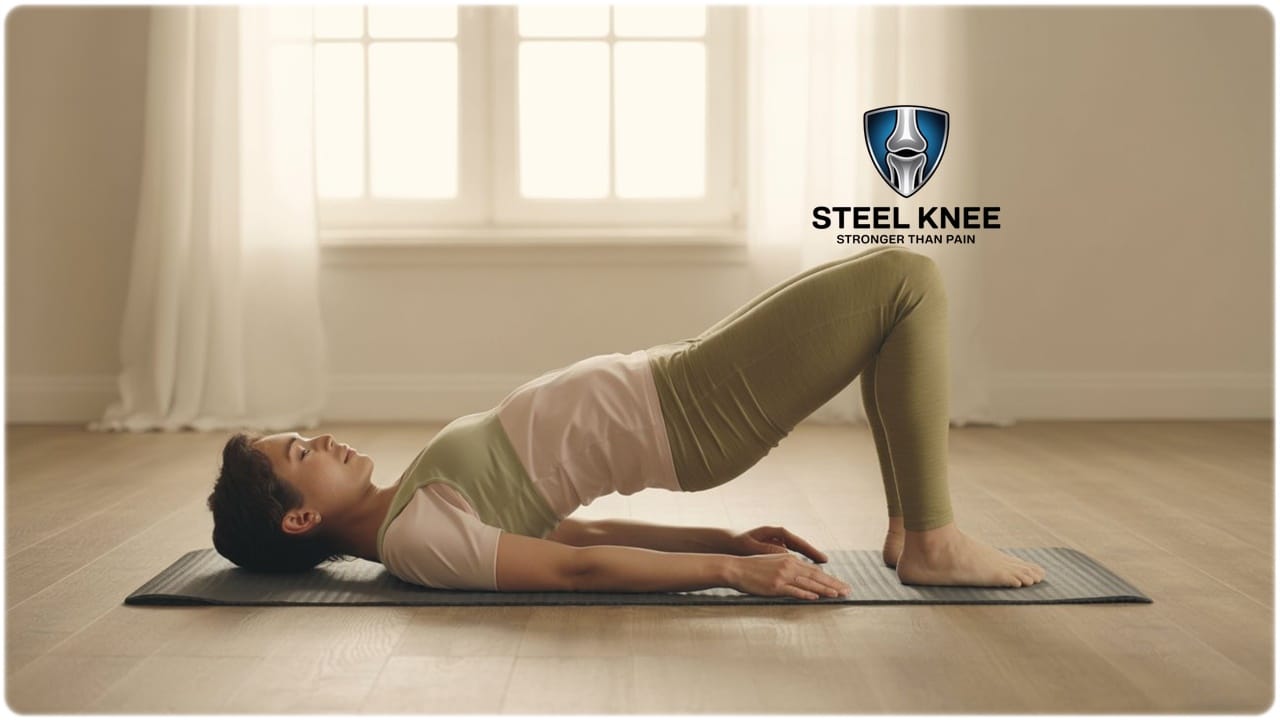
3. Glute Bridge
While the glute bridge doesn’t directly target the knee, it’s one of the most important exercises for lower-body balance.
It primarily works the glutes and hamstrings, which play a major supporting role in protecting the knee joint.
Weak glutes are a surprisingly common contributor to knee problems — when the hips don’t do their share of the work, the knees often compensate, leading to pain and dysfunction.
This exercise corrects that imbalance.
How to do it:
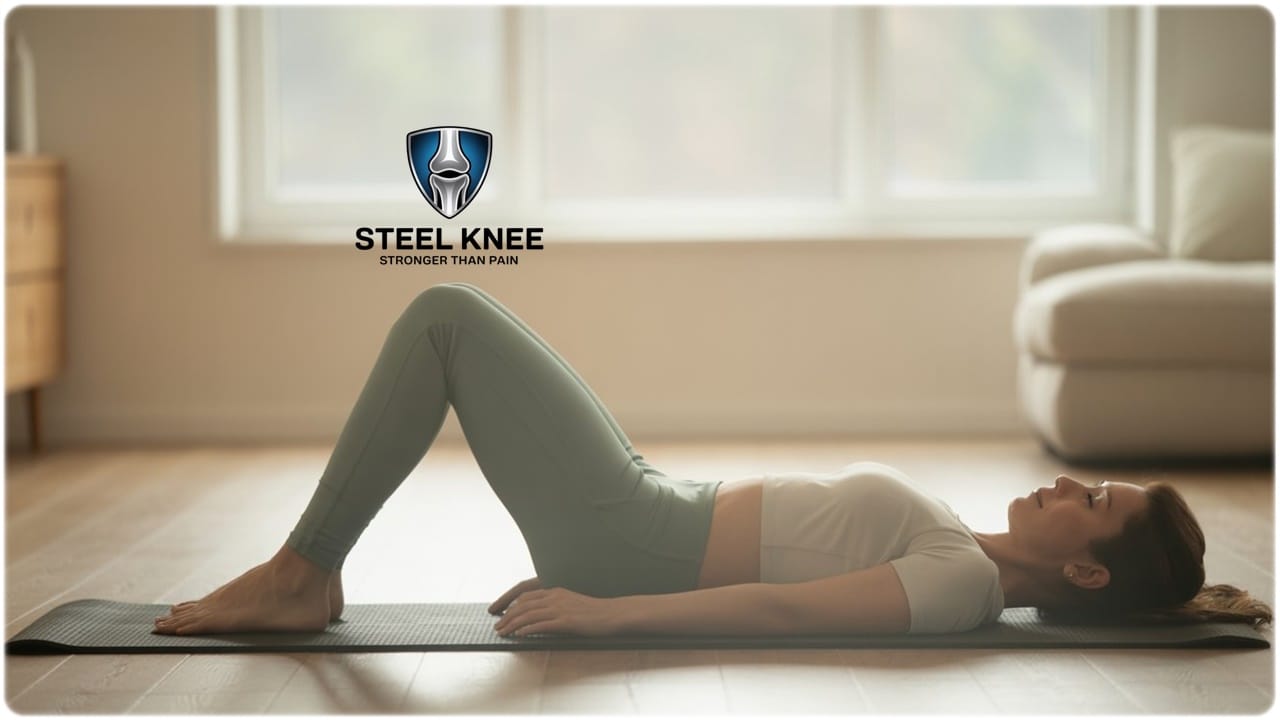
Lie on your back with knees bent and feet flat on the floor, hip-width apart.
Rest your arms alongside your body.
Squeeze your glutes and drive your hips upward until your body forms a straight diagonal line from shoulders to knees.
Hold at the top for 3 seconds, then slowly return to the starting position.
Perform 3 sets of 12–15 reps.
Clinical note:
Avoid pushing through your shoulders or overextending your lower back. The movement should come entirely from your glutes. This is an especially useful exercise for runners and regular walkers.
4. Seated Knee Extension
This simple chair-based exercise is a go-to for beginners, older adults, and anyone in a rehabilitation program.
It isolates the quadriceps directly, helping to restore knee function for everyday tasks like walking and navigating stairs.
It’s particularly recommended for people with patellar chondromalacia, knee osteoarthritis, or those recovering from orthopedic procedures.
How to do it:
Sit upright in a sturdy chair with your back supported and both feet on the floor.
Slowly straighten one leg until it’s fully extended and parallel to the ground.
Hold for 2 seconds, then lower the leg in a controlled motion.
Repeat 10–15 times per leg.
Progression tip:
A light ankle weight can be added to increase resistance over time — always under the guidance of a healthcare professional.
Why it matters:
By isolating the quadriceps, this movement trains the muscle most responsible for shock absorption and knee control during activities like descending stairs or stepping off a curb.
5. Forward Lunge
The lunge is a functional, full-body lower-limb exercise that challenges strength, coordination, and balance simultaneously.
It targets the quadriceps, glutes, and hamstrings in an alternating pattern, while also developing the neuromuscular control needed to prevent stumbles and falls.
Because it mimics real-life movements — like taking a long stride or lowering yourself to the ground — it translates directly to improved everyday mobility.
How to do it:
Stand tall with feet together and core engaged.
Step forward with one leg, lowering your body until both knees form roughly 90-degree angles.
Make sure the front knee stays directly above the ankle and doesn’t push forward past the toes.
Push back to the starting position and alternate legs.
Aim for 2–3 sets of 10 reps per side.
Key tips:
Keep your torso upright and avoid leaning forward.
If you experience discomfort, reduce your range of motion and stop if pain increases.
Important Precautions Before You Begin
If you’re currently dealing with knee pain, have undergone surgery, or carry a diagnosis such as osteoarthritis or a meniscus tear, please consult an orthopedic specialist before starting any new exercise program.
Professional guidance ensures that the movements you choose are appropriate for your specific condition — and prevents well-meaning effort from accidentally causing further harm.
Building Your Routine
Consistency matters far more than intensity, especially when you’re just getting started. Here’s a simple framework:
Train 2 to 3 times per week, with at least one rest day between sessions.
Move slowly and deliberately — controlled technique beats speed every time.
Breathe steadily throughout each exercise; never hold your breath.
Gradually increase duration or repetitions as your strength improves.
These five exercises provide a solid foundation. That said, working with a professional can help you progress faster and avoid setbacks.
When to See an Orthopedic Specialist
Certain symptoms are a clear signal to seek expert evaluation:
A feeling of instability or “giving way” in the joint
Recurring swelling or prolonged morning stiffness
Clicking or popping sounds accompanied by pain
Difficulty going up or down stairs
Final Thoughts
Strengthening your knees at home is not only achievable — it’s a genuinely practical and accessible investment in your long-term health.
These five exercises work the key muscle groups that protect and stabilize the joint, helping you move with greater confidence, less discomfort, and a lower risk of injury.
Start small, stay consistent, and always listen to your body.
If you have any concerns or experience unusual discomfort, don’t hesitate to schedule an evaluation with a qualified orthopedic specialist.
We use cookies to ensure that we give you the best experience on our website. If you continue to use this site we will assume that you are happy with it