Knee Pain Going Up and Down Stairs? 5 Fixes That Actually Work
Spread Health and Love
I’ve seen people avoid the second floor of their own house just to skip that sharp pinch in the knee going up.
And I get it completely — I’ve spent years helping people rebuild mobility, and “my knee pain gets so much worse on stairs” is hands-down one of the most common complaints I hear.
It makes sense, too. Climbing or descending steps looks simple, but mechanically it’s one of the heaviest loads we put on our bodies.
Walking on flat ground puts about 1.5 to 2 times your body weight through the knee.
The Real Reason Your Knee Pain Never Goes Away
It's not age. It's not "just wear and tear." Most people are missing the root cause — and this natural formula targets it directly, fast.
Stairs push that number up to 3 to 5 times your body weight, with almost all of that force landing right at the joint between your kneecap and thighbone (the patellofemoral joint).
The good news:
this isn’t a life sentence. In most cases, knee pain going up or down stairs comes down to muscle compensations and alignment mistakes — things you can actually fix. Here are the 5 adjustments I use and still recommend today.
Does the Order You Step With Actually Matter?
There’s an old physical therapy saying I repeat to almost everyone who comes to me with knee pain:
“the good goes up to heaven, the bad goes down to hell.” Sounds silly, but it works.
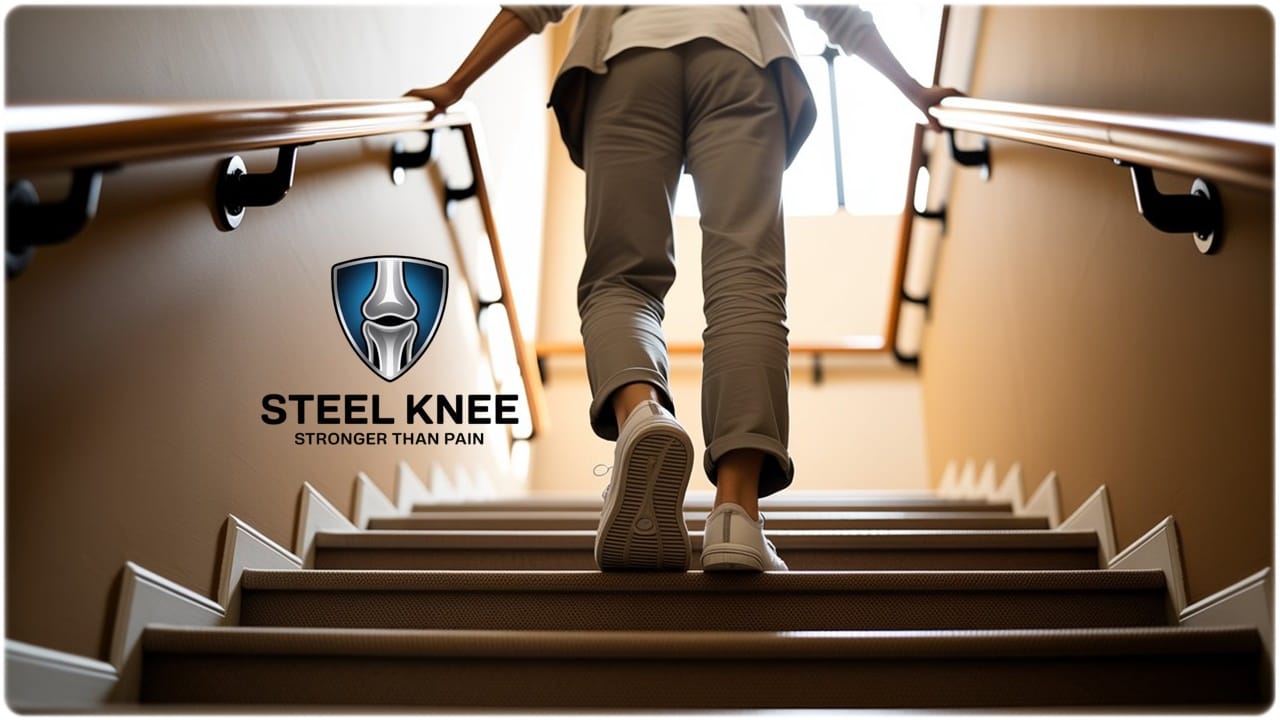
Going up: lead with your stronger leg, the one that hurts less. It climbs the step first and pulls the rest of your body up. The painful leg just follows along.
Going down: flip it. The painful leg goes down first, landing on the lower step. That way, your healthy leg stays up top, controlling and absorbing the weight, sparing the weaker joint from the impact of the drop.
A small change in sequence, a big difference in load.
Am I Stepping Wrong on Stairs Without Realizing It?
Probably — and it’s more common than you’d think. Pay attention: are you climbing on just the balls of your feet, with your heel floating off the step?
If so, that’s one of the sneakiest causes of knee pain on stairs.
This pattern shifts almost all the effort to the front of the thigh, forcing the patellar tendon to pull the kneecap against the thighbone with unnecessary force — which makes tendinitis and joint wear worse over time.
The fix is simple: plant your whole foot, from toes to heel, and as you push up, mentally focus the effort through your heel.
That activates your glutes and hamstrings — the biggest force generators in your body — and takes a serious load off the knee almost instantly.
The Most Common Stair Mistakes (and What They Do to Your Joints)
Here’s a quick rundown of the patterns I see most often:
Stepping on your toes overloads the patellar tendon and jams pressure into the kneecap. Fix: plant the whole foot, push through the heel.
Knee caving inward (valgus collapse) creates lateral twisting and uneven cartilage wear. Fix: keep the knee tracking in line with your second toe.
Running down stairs kills muscular control and multiplies impact with every step. Fix: slow, controlled descent.
Skipping the handrail out of pride forces the joint to absorb 100% of your body weight alone. Fix: use the handrail as a tool, not just an emergency backup.
Is a Knee Caving Inward on Stairs Actually Serious?
It can become serious if it repeats day after day.
It’s the same problem as dynamic knee valgus that shows up during squats:
when the knee collapses inward as you shift weight, the kneecap slides off its natural track and the cartilage wears unevenly.
Here’s the trick I use: before planting each step, I glance down quickly — the middle of my knee should point in the same direction as my second toe.
And skip the runway-style walk of crossing one leg in front of the other; keep your feet about hip-width apart.
Does Leaning Forward on Stairs Really Help Knee Pain?
Yes, quite a bit. The natural reaction when your knee hurts is to stiffen up, stand ultra-straight, or even lean back a little out of fear of falling. That’s actually the opposite of what your body needs.
Keeping your torso perfectly upright increases the mechanical leverage on the knee, forcing the quadriceps to work harder.
But leaning your torso slightly forward from the hip — keeping your spine straight — shifts your center of gravity, moving some of that load off the knee and onto the hip and glutes instead.
It’s basic physics working in your favor.
Is It Worth Using the Handrail, Even If You’re Not Older?
Absolutely, and there’s no reason to feel self-conscious about it.
A lot of middle-aged and even younger people avoid the handrail because it feels like “something for old people.” That’s a mindset worth dropping.
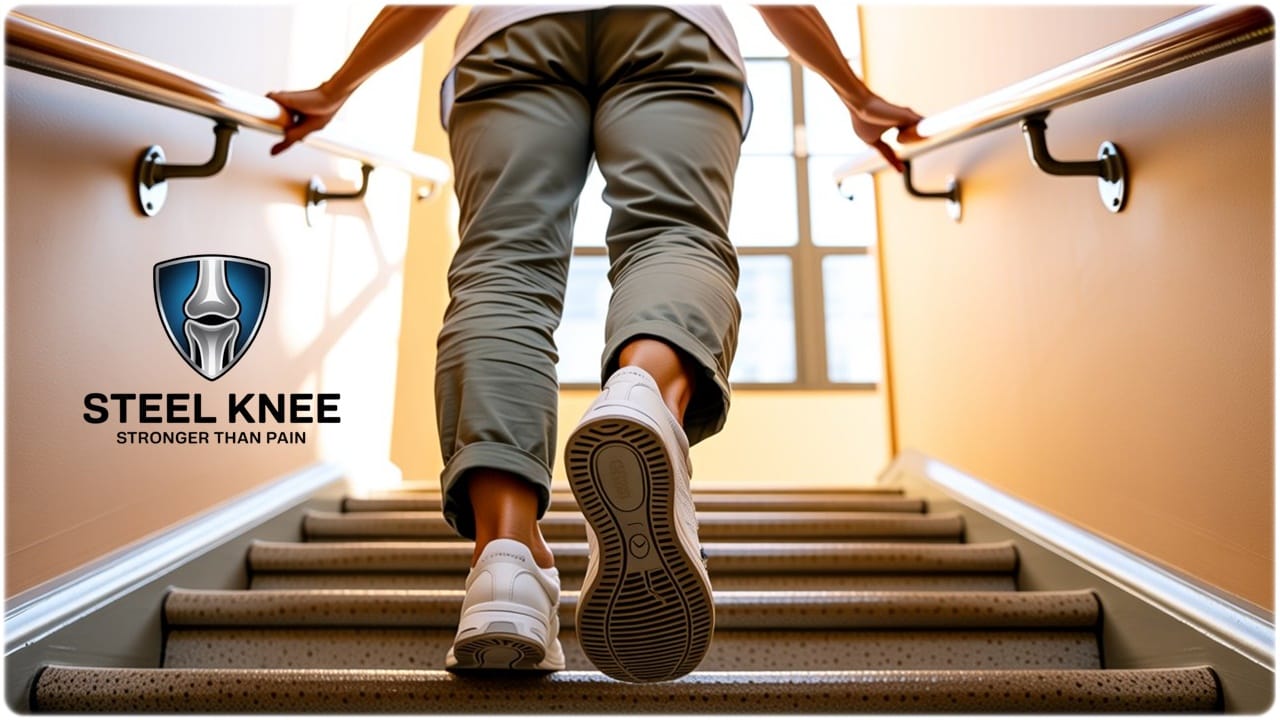
The handrail isn’t just a fall-prevention feature, it’s a real load-relief tool.
By gripping it and gently pulling or pushing your body as you climb or descend, you can offload somewhere between 15% and 25% of your total body weight through your arms.
That’s often exactly the margin your knee needed to move within a pain-free range.
Is It Worth Doing This Even With More Advanced Joint Wear?
Yes — and this is the point where I’m usually most direct with people: complete rest isn’t the answer.
It weakens the muscles and leaves the joint even stiffer, feeding a cycle of more pain and less movement.
A lot of people I’ve worked with managed to delay — and in some cases avoid — knee surgery altogether just by correcting these everyday movement patterns.
That’s obviously not true for everyone, but it shows just how much movement mechanics can shift the equation.
Apply these 5 adjustments consistently and you retrain your neuromuscular pattern, distributing daily load more fairly across your body.
Try them on the next flight of stairs you come across — your knees will thank you fast.
Important note: This article is for informational and educational purposes only. If your knee pain comes with swelling, painful popping or clicking, a sense of the knee “giving out,” or locking up, it’s important to see an orthopedic doctor or trusted physical therapist for a proper diagnosis.
We use cookies to ensure that we give you the best experience on our website. If you continue to use this site we will assume that you are happy with it